

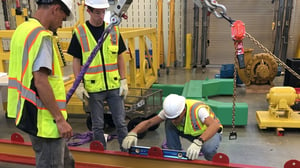
Few construction and industrial roles have as much direct influence on safety as the rigger. Crane-related accidents cause an average of 42 deaths per year and cause costly downtime. The primary cause of accidents is human error, which means most can be prevented with better rigger training.
According to OSHA, it’s the employer’s responsibility to make sure that qualified riggers are on-site to calculate and rig loads and complete inspections before each shift (OSHA 1926).
Here’s everything you need to know about what rigger qualifications and training your team needs, and the best training methods from online to instructor-led.
View upcoming rigger training courses from ITI
What Is Rigger Training?
Rigger training prepares individuals to maintain the safety of suspended loads, typically in construction or industrial settings. A rigger is responsible for securing, lifting, and positioning heavy machinery and equipment, as well as carrying out inspections and communicating with the crane operator.
How Employers Can Verify and Document Rigger Qualification
OSHA describes a qualified rigger as a person who:
- Possesses a recognized degree, certificate, or personal standing; or
- Has extensive knowledge, training, and experience; or
- Can successfully demonstrate the ability to solve problems related to rigging loads.
While OSHA doesn’t require a specific certification, employers are responsible for verifying a rigger’s demonstrated ability for the job. Many employers choose both hands-on training and CCO® certification to validate their skills against nationally recognized standards. ITI's Rigger Level I and Level II programs deliver both, with hands-on qualification aligned with employer needs and thorough exam prep.
The two main CCO rigging certifications are:
- Level I: Ensures that riggers know basic concepts like selecting and inspecting rigging equipment, tying knots and securing loads, and understanding weight capacities. Level I is appropriate for entry-level, supervised rigging and pre-approved rigging plans.
- Level II: Shows that a rigger has advanced mastery of rigging and an in-depth knowledge of load dynamics. Level II certifies that a rigger is capable of creating rigging plans, executing complex loads, and tackling multi-crane operations without supervision.
What Employers Need to Know
To satisfy the requirement that employers have verified a rigger’s abilities, you need a documentation strategy. As you build a training program, consider:
- Comprehensive training documentation rather than informal, on-the-job shadowing.
- A list of core competencies for entry-level and advanced riggers.
- Documentation of evaluations and knowledge checks by a master rigger.
- Using a training platform to house your training content, completions, and certifications in one place.
What Your Riggers Should Be Trained On
A typical rigging curriculum covers a wide range of topics, from load dynamics to rigging configuration. Through ITI’s blended curriculum, learners gain proficiency in:
- Load Handling Safety: Identifying pinch points and hazards related to stabilizing loads; learning appropriate rigging techniques for effective load control. .
- Sling Selection and Inspection: Identifying wear patterns in synthetic, wire rope, and chain slings; understanding how hitches affect working load limits.
- Hardware Evaluation: Inspecting hooks, shackles, turnbuckles, and eyebolts for deformation, cracks, or other failure indicators before use.
- Rigging Methods: Applying proper hitches (vertical, choker, basket) and understanding sling angles' impact on capacity.
- Communication Protocols: Executing clear hand signals and radio procedures to coordinate safely with crane operators.
- Load Control Techniques: Using taglines effectively, managing load drift, and executing controlled load turns.
In-person Rigger Training vs. Online Rigger Training
The best rigging training blends hands-on practice with structured digital learning to build competence that lasts. Hybrid training programs like ITI’s combine learning formats to include:
- Online training: Videos and digital learning modules introduce concepts and theory in an interactive format.
- Simulation-based learning: 3D simulations and virtual reality (VR) enable learners to practice rigging scenarios in a realistic virtual environment.
- Instructor-led training: Learners work with actual slings, shackles, hooks, and turnbuckles under the guidance of master riggers— making early mistakes in a controlled yard before they ever reach a live jobsite.
A hybrid approach helps learners develop critical knowledge and gain confidence in applying it. By learning how to conduct safe, efficient lifts in simulations and controlled environments first, new riggers can minimize the risk of costly errors and accidents.
Benefits of Instructor-Led Training (ILT)
Rigging is a hands-on profession, requiring learners to learn not just head knowledge, but hands-on techniques. Instructor-led training (ILT) guides learners in a safe, controlled setting, ensuring that they have mastered all the skills they need for the job.
There’s nothing like working with real rigging gear to bridge the experience gap. Working with an instructor allows learners to upskill quickly, gain confidence, and learn safely.
While you can have one of your advanced riggers mentor and train novices, this takes capacity away from your workforce that you may not have. Instead, invest in ILT with professional experts with decades of experience.
Different ILT options include:
- Instructor-led courses at local training centers around the country.
- Instructor-led training for a group at your location.
- Virtual online training by expert instructors to supplement field learning.
On-Site Rigger Training Options
For crews requiring coordinated qualification, ITI brings the training yard to you. On-site rigger training allows entire teams to develop consistent practices on your specific equipment and site constraints.
Instead of waiting for individuals to cycle through external courses, crews train together, reducing downtime and increasing training consistency. ITI can tailor scenarios to specific lifts your crew will face. Request an on-site training quote to discuss scheduling, space requirements, and customizing exercises for your operational needs.
Request On-Site Training Quote
Rigging Career Path, Roles, and Job Outlook
- Brief overview of industry demand and advancement opportunities.
- Mention connection between rigging skills and supervisory roles like Lift Director.
As infrastructure projects expand and experienced tradespeople retire, demand for qualified riggers is growing. The median wage for riggers is $27.03 per hour or $56,220 annually, according to the Bureau of Labor Statistics.
Those who master rigging fundamentals can advance into roles like Lift Director, Crane Supervisor, or Safety Coordinator— positions where understanding load dynamics becomes critical to planning entire operations. Rigging training is an investment in a safer, compliant workplace and a skilled workforce.
Get Started with ITI for a Safer, Highly-Trained Workforce
Rigging and lift operations have a direct impact on safety, downtime, and efficiency in your business. Informal rigging training, inconsistent evaluations, and patchy documentation gaps leave you open to human errors and liability. OSHA leaves it up to the employers to make sure riggers are qualified— that means it’s up to you to provide the best rigger training possible.
Contact ITI to get started with next steps:
- View ITI’s rigger training schedule
- Request a quote for on-site training
- Explore ITI’s rigger certification prep
COMMENTS