A Unique Lifting Environment
Crane operations at Bruce Power take place in a uniquely complex and carefully managed environment. Operators routinely perform lifts over safety-critical systems, including fuel handling in submerged bays and lifts within reactor vaults. These tasks are often executed in confined spaces with limited visibility, under strict procedural control.
“Safety is the lens through which all work is performed,” explains Chris McMichael, Training Manager at Bruce Power. “When it comes to the reactor, ‘cool, contain, and control’ are the principles that shape how all work is executed.”
While the organization maintains a highly structured training program, operators have historically had limited opportunities to gain hands-on experience.
At the same time, maintaining proficiency is essential. Operators must be ready to execute lifts, and without regular practice, these skills can quickly degrade.
Bridging the Gap Between Training and Field Execution
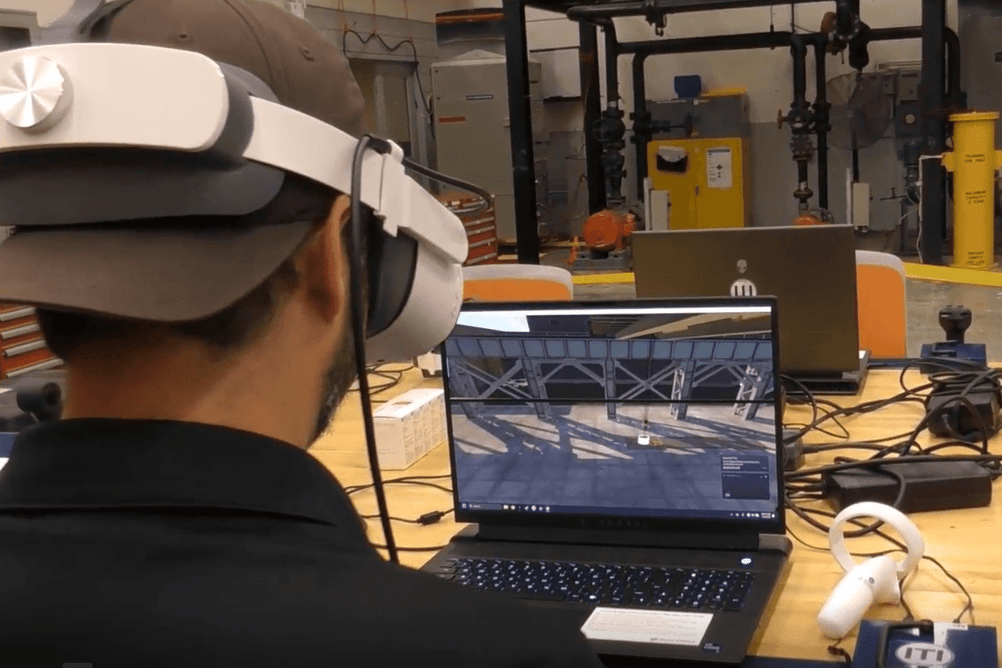
One way Bruce Power has addressed this gap is by integrating ITI’s VR Crane Simulator into the shop portion of its training program.
In this phase, trainees practice hoisting, trolley movement, bridge travel, and load control using configurations that mirror real equipment. This builds familiarity, improves control, and increases confidence before transitioning to live equipment. As a result, the learning curve is reduced, and overall operator readiness is strengthened.
Chris shares, “Every time we run training, we collect feedback about the VR, and it’s been nothing but positive reviews from operators and maintainers.”
Qualification and Skill Development
Bruce Power’s crane and rigging program is built around three qualification levels: Task-Specific Pre-Engineered lifts (TSPE), Skilled, and Master.
The Skilled level represents 75-80% of qualified personnel on-site, particularly mechanical maintenance staff like millwrights, boilermakers, and industrial mechanics. At this level, operators perform intermediate rigging and lifting tasks, applying working knowledge of load charts, sling angles, and capacity limits. It’s also at this stage that VR plays a significant role, providing operators with a controlled environment to build and refine core skills such as load control, swing management, and spatial awareness.
Yet at all qualification levels, maintaining proficiency is an ongoing challenge.
As a result, Chris shares Bruce Power’s training approach: “Train the right people at the right time for the right work.”
Preventing Perishable Skills
The organization intentionally limits the number of employees who hold each qualification, ensuring those individuals maintain relevant, field-ready skills. ITI’s VR Crane Simulator reinforces this approach by giving operators a reliable way to practice, assess, and refresh skills between live lift opportunities, while also supporting Bruce Power’s structured recall process.
Operator’s skills are recalled every three years across all qualification levels, with a minimum of four documented proof-of-practice lifts annually to reinforce hands-on capability.
The importance of this approach is clear to Chris in practice. During two separate VR training sessions, he observed his mechanics complete simulation scenarios with minimal issues, while their supervisors—who hadn’t recently performed fieldwork—struggled to pass. As Chris points out, “it shows the value of this training. It’s not a lack of knowledge; it’s that skills degrade quickly without regular practice.”
Training Across a Complex Crane Fleet
Bruce Power operates more than 200 cranes across its site, including mobile cranes, Broderson carry deck cranes, overhead cab cranes, pendant cranes, jib cranes, monorails, and gantry systems, requiring operators to work across a wide range of equipment types and configurations.
Operators are trained and qualified on specific crane types based on equipment and capacity, and VR is integrated into these programs, allowing instructors to replicate different crane types in a controlled environment. This enables trainees to build familiarity and qualify across multiple types without needing access to live equipment.
“The versatility of the VR crane is fabulous,” says Chris. “All we need to do is change the controllers out and run a different program.”
Just-in-Time Training for Outages
Planned outages are the most critical operational periods, where maintenance must be completed within tight timelines. Delays carry real consequences, impacting outage schedules, commitments to the electrical grid, and financial costs.
To prepare, Bruce Power uses VR for just-in-time training for both internal teams and supplemental staff, running simulations before outages to refresh skills and ensure readiness. Even when supplemental staff arrive with external certifications, Bruce Power validates their skills on the simulator first, ensuring they meet site-specific expectations before working in the field.
“During planned outages, we can have hundreds of supplemental staff coming in, so having the VR simulator is crucial for safety and getting ahead of any preventable delays.”
A More Robust Training Model
VR has strengthened Bruce Power’s existing training program by adding a safe, hands-on layer that improves and refreshes operator preparedness.
Operators now enter the field with greater control and experience, better prepared to execute lifts safely and avoid outage delays.
As Chris puts it, “Without ITI’s VR Crane Simulator, we’d be delivering training like we were 20 years ago.”