
Skip to content
Metallus Doubles Operator Seat Time With VR Crane Simulator

Metallus Doubles Operator Seat Time
With VR Crane Simulator

  • Key Successes
  • Summary
  • About Metallus Inc.
  • Training Program Goals and Challenges

Key Successes

  • Doubled hands-on seat time during new hire onboarding.
  • Expanded trainer capacity with supplemental training tools.
  • Accelerated skill development in a risk-free environment.
  • Increased operator confidence transitioning from VR to real equipment.
  • Strengthened recruitment efforts using VR as an engagement tool.

Summary

  • Metallus, a long-standing steel producer in Canton, OH, aimed to modernize its approach to attracting and preparing the next generation of manufacturing talent.
  • Facing a widening skills gap and hiring new employees with little to no manufacturing experience, the company needed an onboarding model that was more engaging than traditional lecture-based training.
  • By integrating ITI’s VR Crane Simulator, Metallus created an appealing entry point for younger candidates, generating strong interest at high schools and career fairs.
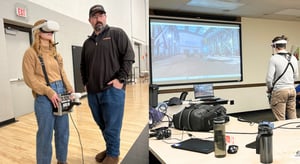
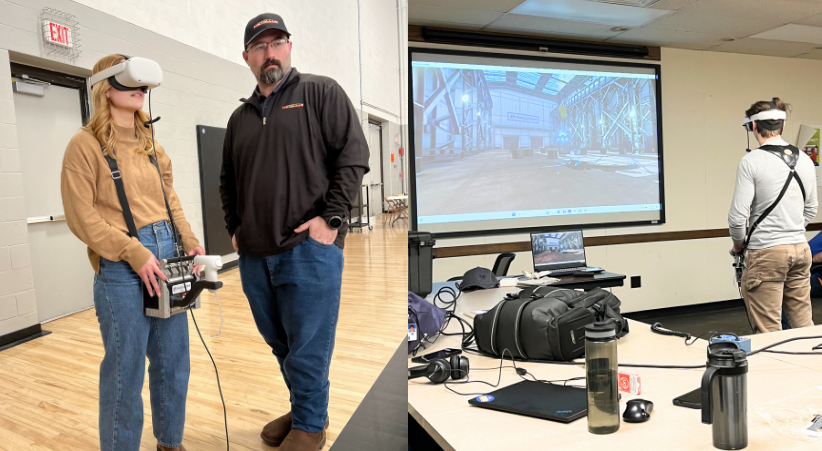
  • The simulator now serves as the centerpiece of a revamped two-week blended onboarding program for MSOs, combining VR practice with classroom instruction and hands-on training on live equipment.
  • Trainers leverage VR to safely prepare new hires before they approach real machinery, reducing stress, freeing up trainer bandwidth, and allowing multiple operators to train simultaneously.
  • The VR-enhanced program doubled new-hire seat time and accelerated skill development, resulting in faster ramp times and more confident crane operators.

About Metallus Inc.

Metallus Inc. is a century-old leader in the steel manufacturing industry. Its operations depend on extensive overhead crane activity, supported by rigorous internal logistics and safety programs. The company trains a wide range of skilled professionals, including Millwrights, Electricians, and Maintenance Service Operators (MSOs), and remains committed to creating a modern, safe, and engaging environment where employees can build long-term careers.METALLUS logo
 

Training Program Goals and Challenges

Training Goals

  • Attract and engage new crane operator talent with modern, tech-forward training tools.
  • Reinforce critical safety behaviors in a risk-free environment.
  • Develop core crane operating skills that transfer across all types of equipment.
  • Increase hands-on seat time to accelerate new-hire readiness.

Training Challenges

  • New hires entering the industry with no crane or industrial experience created a significant skills gap.
  • The intimidating steel mill environment caused stress and reduced trainee confidence, slowing ramp time.
  • Outdated, lecture-heavy training failed to engage a new generation of learners.
  • Limited trainer capacity and equipment constrained hands-on learning opportunities.
Metallus Doubles Operator Seat Time With VR Crane Simulator
  • Read the Story

Traditional Training Couldn’t Meet a Modern Workforce

Metallus hires approximately 70–75 new MSOs each year, most of whom must quickly learn to operate overhead cranes in a large-scale industrial environment. For years, the company recruited candidates with manufacturing experience; however, as the talent pool shrank and competition for skilled workers intensified, Metallus broadened its hiring strategy to include individuals with little to no industrial background.

“For someone who has never been in a steel mill, the dangerous environment and the scale of the equipment can be intimidating and overwhelming. The sounds and the heat can all be a real shock,” explained Mike Constantine, Training Team Manager at Metallus.

As more first-time industrial workers joined the workforce, it became clear that the legacy training model, which relied on PowerPoint presentations and one-at-a-time practice on a retired crane, was no longer sufficient. Beginners needed far more supervision, safe and structured support, and a lot more hands-on practice than the old approach could provide.


ITI’s VR Crane Simulator as a Scalable Training Bridge

The ITI VR Crane Simulator provided the intermediate step the team had been missing. By offering a repeatable, risk-free environment, the simulator enabled new hires to safely learn the fundamentals before ever entering the mill.

Metallus integrated a four-hour VR block into its two-week MSO onboarding program, immediately expanding instructional capacity. Unlike the physical cranes, the VR simulator could support continuous practice without tying up equipment or instructors. John Lidderdale, Union Safety Training Rep, shared,

“I don’t have to babysit the VR, and I’m completely doubling the amount of time our new hires actually get to operate the crane.” 

With VR absorbing much of the basic skill development, trainers could focus their in-person time on higher-value coaching rather than managing early-stage mistakes, while also stepping back earlier as operators explored the learning process safely on their own.


Accelerated Skill Development and Stronger Operator Confidence

Once VR was incorporated, Metallus saw rapid improvement in both skill progression and trainee confidence.

New operators begin their training in VR on a basic single-hoist crane (75- or 100-ton), practicing core movements, load control, and safety protocols before transitioning to single and dual-hoist cranes in the tube mills. This sequencing would have been impossible without the use of the simulator.

VR also makes advanced training scenarios safe and accessible far earlier in the process — techniques such as catching load swing, performing inspections, and complex tasks like plate flipping.

“Historically, I wouldn’t dare assign a task like plate flipping so early on in the training process. But with the VR, I can advance their skill level safely and much faster than in real life,” John explains.


A New Advantage: Recruitment and Culture Building

The VR simulator has also become a powerful recruitment tool. At high schools, career fairs, and hiring events, Metallus’s booth consistently draws the longest lines.

“Our line is always way longer than anyone else’s. People see the VR headset and immediately want to try it. It’s become a great recruiting tool for us,” Mike notes.

Inside the onboarding program, exercises like magnet stacking create camaraderie and make training more engaging. VR levels the playing field for inexperienced hires and helps them open up more quickly. 

“It brings everyone down to the same level,” John said. “It helps them loosen up and start talking. It’s huge for our culture.”


Looking Ahead

The ITI VR Crane Simulator has become an essential part of Metallus’s safety and workforce development strategy. The team continues to explore how VR can support refresher training, remedial learning, and annual safety stand-ups.

What started as a tool to bridge a skills gap has become a catalyst for safer training, stronger operator confidence, and a more modern, engaging manufacturing culture.

SEE IT IN ACTION

Schedule Time with a Training Expert to Learn More