

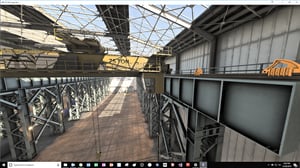
Cleveland-Cliffs, one of North America’s largest steel producers, relies heavily on overhead cranes to move steel and materials safely through manufacturing environments. As experienced operators retire and new employees step into highly technical roles, the company has adopted ITI, an Interplay Learning company’s VR Crane Simulator, to provide consistent, safety-focused onboarding across seven sites, helping new operators build skills and confidence before working with live cranes.
Training Within Live Production Environments
Before the introduction of VR simulation, crane training at the Mansfield site followed a traditional model. New hires learned primarily by shadowing experienced operators and gradually took on more responsibility as opportunities arose.
“It was mostly job shadowing,” said Brian Smith, Training Coordinator at the Mansfield facility. “How much hands-on time someone got really depended on what jobs were running and whether equipment was available.”
For floor-controlled cranes, that meant learning complex movements, swing control, and spatial awareness in an active environment. Training opportunities varied based on schedules, staffing, and operational priorities, making it difficult to provide a consistent and repeatable learning experience for every new operator.
While safety procedures were always in place, Smith noted that learning crane fundamentals in this setting required careful coordination and vigilance.
“You’re working around people, equipment, and ongoing jobs,” he said. “A lot is happening at once.”
As a result, Cleveland-Cliffs looked for a way to give new operators more structured and repeatable practice earlier in the process, without being limited by production schedules or equipment availability.
Bringing VR Into the Training Process
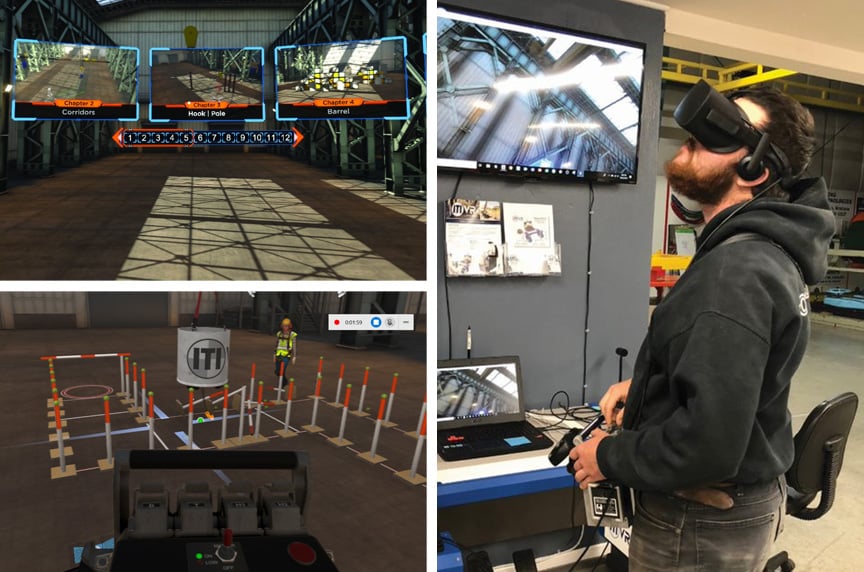
At the Mansfield site, the ITI VR Crane Simulator is used primarily to support early crane training for new hires. Rather than waiting for the right conditions on the production floor, Smith brings new operators into the simulator to introduce crane fundamentals in a controlled environment.
New operators typically begin in VR, where they can focus on learning the basics without the pressure of live operations.
“They can get in there and have at it,” Smith said. “They don’t have to worry about tearing anything up.”
In the simulator, trainees practice essential skills such as basic bridge, trolley, and hoist movements, load control, swing prevention, and operating floor-controlled cranes using a belly box. Because the controls and layouts closely mirror real equipment, operators begin developing muscle memory early in the process.
The simulator also provides Smith with a way to expose trainees to scenarios they may not encounter immediately on the floor, helping to build familiarity and confidence before they’re responsible for live loads.
A Real Example From the Floor
Smith points to their most recent hire, Kaden, as a clear example of how simulation fits into the training process. Before joining Cleveland Cliffs, Kaden worked in material handling for an asphalt company. While he was comfortable around equipment, overhead cranes were a new experience for him.
Smith started him in the simulator on his first day.
“We start with a tutorial that has them lift a load and then use bridge and trolley control functions,” Smith explained. “It walks them through every function, helping them get comfortable with the controls and how the crane operates. From there, we build up.”
A major focus was swing control, one of the most critical skills for crane operators. Through repeated VR practice, Kaden learned not only how to stop a swinging load, but how to prevent it from starting in the first place.
The difference carried over to the floor.
“He told me he could already feel a difference when he practiced with the real crane,” Smith said. “After spending time in the simulator, he felt more confident and more in control.”
For Smith, that confidence matters just as much as technical ability.
“That tells me it’s working,” he said. “It gives me more assurance before sending someone out to make their first live lift on a production line, whether they’re loading scrap or moving sheets of metal.”
Cutting Training Time without Compromising Safety
While safety is the top priority, time savings are also a significant benefit. According to Smith, starting operators in VR can shorten the path to real-world readiness by weeks.
“ This closes the gap,” he explained. “They’re learning the area, the controls, and the procedures at the same time, well before their feet are put to the fire.”
That matters operationally. When an operator isn’t qualified, someone else must step in, often resulting in double staffing and higher labor costs. Faster onboarding means operators become productive sooner without compromising safety.
Preparing for New Equipment Before It Arrives
Simulation has also become a useful tool as Mansfield prepares for equipment upgrades.
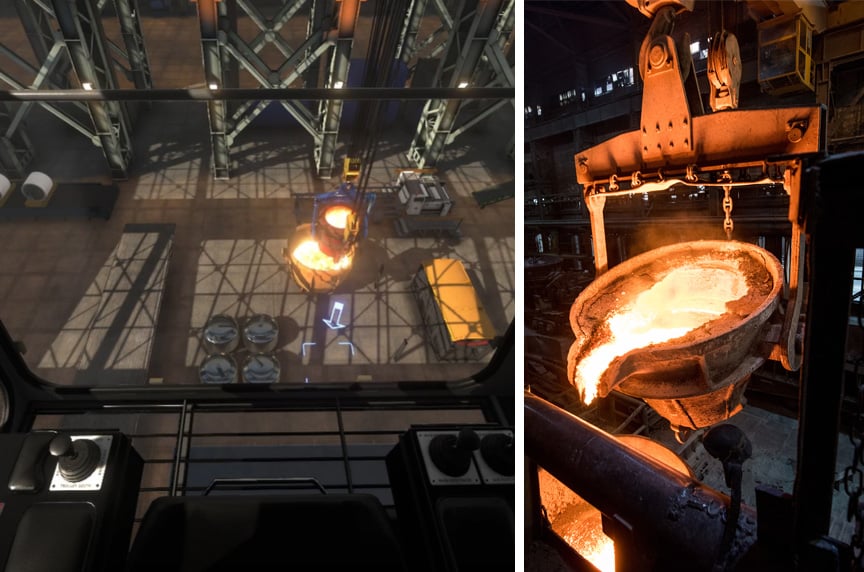
The facility recently completed the installation of a new 150-ton charge crane, introducing operating characteristics the team had not previously worked with. One of the biggest changes was regenerative braking, which alters how the crane responds when the controls are centered.
“With our older cranes, you center the controls and the crane just coasts unless you actively brake or plug it,” Smith said. “With this new crane, when you center the controls, it automatically slows itself down. No one here is used to that.”
Rather than waiting until the crane was live to introduce those differences, Smith used simulation to help operators build familiarity ahead of time.
“They had an idea of what to expect before they ever touched it,” he said. “That’s huge.”
This approach allowed training to take place on-site, without pulling operators off their jobs or requiring travel to another facility with similar equipment. By using simulation to support the transition, Mansfield aligned operator readiness with the equipment upgrade, helping ensure a smooth rollout and confident operators from day one.
Part of a Broader Training Approach
Cleveland-Cliffs views VR as one piece of a larger training strategy, not a replacement for hands-on experience. By combining simulation with instructor-led training and hands-on job-shadowing with live equipment, the company can more effectively assess readiness and support consistent training practices across all sites.
The technology also resonates with newer workers entering the trades.
“They grew up with this stuff,” Smith added. “Some of them already have VR at home. They jump right in.”
As experienced operators retire and fewer workers enter industrial roles, tools like VR simulation help make training more accessible, repeatable, and engaging for a new generation.
A Practical Tool With Real Impact
For other Cleveland Cliff sites and manufacturers considering crane simulation, Smith keeps it simple.
“It’s a good tool, especially if you’re bringing in a lot of new people. It’s a great stepping stone up to the real thing.”
At Mansfield, the simulator has helped reduce risk, shorten training timelines, and build confidence before operators take control of live cranes. And as Cleveland-Cliffs continues to upgrade equipment and develop its younger workforce, simulation is playing an increasingly practical role in how operators are trained across their seven national sites.
COMMENTS